ASRH and Stroke Center Certification
Stroke Society of the Philippines (SSP) | Committee on Certifications
In Partnership with the World Stroke Organization (WSO)
Official Program Announcement and Institutional Reference Guide
1. Executive Summary & Core Mission
Stroke remains one of the leading causes of death and long-term disability within the Philippines. The structural quality of specialized care delivered in the critical hours immediately following stroke onset is the single most vital factor determining patient survival, functional recovery, and long-term clinical outcomes.
To address this national healthcare priority, the Stroke Society of the Philippines (SSP), in direct collaboration with the World Stroke Organization (WSO), has established a unified, internationally aligned three-tier certification framework. This program serves as a progressive development pathway for Philippine medical institutions to elevate, standardize, and formally recognize their acute stroke care capabilities.
2. The Three-Tier Certification Pathway
The program establishes a clear, progressive pathway for hospitals at any stage of stroke service development:
Tier 1: Acute Stroke Ready Hospital (ASRH)
- Certifying Body: Stroke Society of the Philippines (SSP).
- Key Focus: Foundational acute stroke readiness, emergency medical response, and immediate intravenous thrombolysis capability.
- Core Requirements: Sustained 24/7 coverage by an Acute Stroke Team (AST) with emergency response times < 15 minutes, round-the-clock cranial CT availability (performed within 25 minutes and interpreted within 60 minutes of ordering), and a reliable pharmacy stock of at least two vials of alteplase or tenecteplase at any given time.
- Site Visit: Not mandatory for standard baseline review; verification is conducted via localized process tracking.
- Certification Fee: PHP 8,000 for private institutions | PHP 6,000 for government and public facilities.
- Validity Period: 1 to 3 years, depending on specific sub-category compliance.
Tier 2: Essential Stroke Center
- Certifying Body: Jointly administered by the SSP and the WSO.
- Key Focus: Establishment of a geographically dedicated, specialized stroke unit or a structured cluster-bed model managed under strict evidence-based pathways.
- Core Requirements: Active baseline compliance with 13 mandatory WSO quality performance indicators (KPIs). Institutions must possess a designated Stroke Director and a Nurse Coordinator, alongside an interdisciplinary task force meeting monthly to guide performance data review.
- Registry Data: A minimum prerequisite of 12 months of continuous, active stroke data entry into the hospital database or the WSO/RES-Q registry prior to evaluation.
- Site Visit: Mandatory in-person evaluation conducted by a combined team of local SSP and international WSO assessors.
- Certification Fee: USD 1,000 for private hospitals | USD 500 for government and public facilities.
- Validity Period: 3 years, conditional upon mandatory annual KPI data uploads through the official registry portal.
Tier 3: Advanced Stroke Center
- Certifying Body: Jointly administered by the SSP and the WSO.
- Key Focus: Provision of the absolute highest level of comprehensive stroke care, advanced interventions, and academic leadership, serving as the central apex and regional hub of the national stroke network.
- Core Requirements: Full, continuous 24/7 availability of specialized endovascular thrombectomy (EVT) workflows headed by a credentialed neurointerventionalist, around-the-clock emergency neurosurgery for decompressive hemicraniectomy, advanced diagnostic infrastructure (including on-site MRI and CT/MR angiography), and an operational on-site intensive care unit (ICU).
- Volume Metrics & Indicators: Demonstrated performance of a minimum of 10 endovascular thrombectomies per calendar year and continuous data entry across all 17 total WSO quality indicators.
- Site Visit: Mandatory, rigorous in-person structural and clinical case-tracer review.
- Certification Fee: USD 1,000 for private hospitals | USD 500 for government and public facilities.
- Validity Period: 3 years, backed by ongoing monitoring and institutional verification cycles.
3. End-to-End Application Workflow
The evaluation and intake framework coordinates responsibilities across regional and national channels via a structured 7-stage workflow:
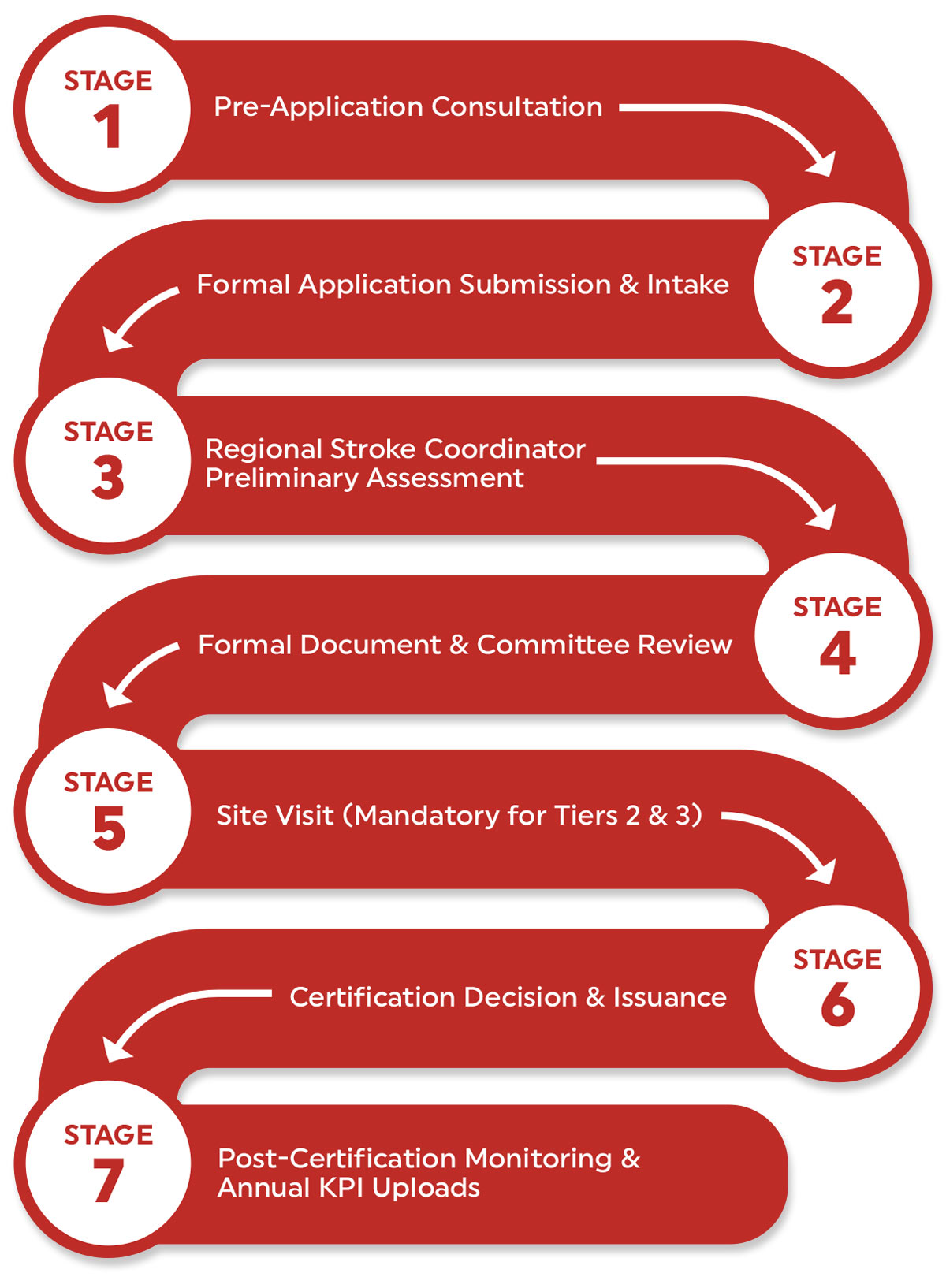
- Stage 1: Inquiry & Pre-Application Consultation: Applying institutions will be in contact with their Regional Stroke Coordinator (RSC) or the national coordinator (if a rñan RSC is not available). The RSC guides the hospital’s Stroke Coordinator through a preliminary readiness self-assessment checklist to verify structural capability and determine the appropriate target tier.
- Stage 2: Formal Application Submission: Tier 1 applicants fill out the Hospital Certification Application Form and Document Submission Checklist; and compile their required portfolios, a CEO/MD-signed Letter of Intent, and an Attestation Letter into a unified PDF file submitted to the SSP Certifications Committee at certifications.ssp@gmail.com. Tier 2 and Tier 3 facilities submit their clinical profiles and address a 91-question structured self-assessment directly through the centralized international WSO online certification portal.
- Stage 3: Regional Stroke Coordinator Preliminary Assessment: The assigned RSC performs a localized quality check on the documentation within 20 working days. The RSC delivers a binding compliance report and formal recommendation to the national committee.
- Stage 4: Formal Document & Committee Review: The SSP Committee on Certifications conducts a rigorous structural assessment of the validation files within 15 working days, coordinating findings in parallel with the WSO committee for Tier 2 and Tier 3 pipelines to clear or schedule site itineraries.
- Stage 5: Site Visit Execution: A formal, structured site review team handles on-site operational verification through strict facility tours, cross-disciplinary staff interviews, and real case-tracer data validation checks. This is mandatory for Tier 2 and 3 applicants, and as necessary for Tier 1.
- Stage 6: Certification Decision & Issuance: Official notifications (Certified, Conditionally Certified, or Deferred) are formally released by the executive board.
- Stage 7: Post-Certification Monitoring: Certified facilities remain under continuous quality surveillance, requiring mandatory annual data tracking uploads to ensure compliance through their registry profiles.
4. Key Deadlines and Central Contact Directory
To maintain uninterrupted administrative and clinical status, existing facilities seeking renewal must file their recertification packages strictly within the following time constraints:
- Tier 1 (ASRH): No later than 2 months before the current certificate expires.
- Tier 2 & Tier 3 (Stroke Centers): No later than 3 months before the current certificate expires.
5. Contact and Submission Routing
For all application tracking inquiries, protocol templates, document checklists, and submission routing, coordinate directly with the national executive office:
- SSP Committee on Certifications: certifications.ssp@gmail.com
- SSP Central Secretariat (CC Routing): ssp_secretariat@yahoo.com
- International Stroke Portal (Tier 2/3): world-stroke.org/stroke-center-certification
6. Documents
The documents, forms, and process workflows related to the SSP ASRH and SSP-WSO Stroke Center Certification Program may be downloaded here:
- SSP ASRH and SSP-WSO Stroke Center Certification Program
- Pre-Application Self-Assessment Checklist Tier 1
- Pre-Application Self-Assessment Checklist Tier 2 and 3
- Hospital Certification Application Form
- Document Submission Checklist
- Site Visit Facility Tour Checklist
- RSC Preliminary Assessment Report
- Regional Certification Status Report
Find the nearest SSP Certified ACUTE STROKE Ready Hospitals.
Click on the link below.